Table Of Content

A Passivhaus is relatively cheap to run due to the low demand on heating and cooling, and energy efficient appliances. The Passivhaus has a continuous airtight barrier that protects the building from air leakage, heat losses and improves overall thermal comfort. Despite its incredible reputation as the gold standard for sustainable building design, the Passivhaus standard is still not fully understood by many within the profession. At a time when climate change is forcing people across the AEC industry to rethink the way in which they build, awareness of this standard is more critical than ever. Yet, strategies for increasing the sustainability of buildings have been around for decades.
In terms of energy use, how does a passive house compare to a standard house?
The gap between our glove and jacket is a thermal bridge, as is the zipper, which often has an extra flap of insulation to cover it. As long as your contractor loves building, they can learn how to do a Passive House easily. There are a number of contractor training courses available, and the community of contractors and craftspeople familiar with Passive House is constantly growing. Once they take contractor training, contractors should host kickoff meetings with subcontractors to ensure that everyone knows what the goals are. PHIUS was originally an affiliate and approved trainer and certifier for the Passive House Institute.
Net-zero energy homes
In 1905, Susanna Bransford Emery-Holmes—known as the Silver Queen thanks to the source of her late husband’s fortune—purchased the home and soon made it her own. In 1922, she spent $37,000 to have the Postle Company of Los Angeles, who also built the Pasadena Playhouse, remodel it into an English Tudor Revival–style mansion, giving it the regal exterior that remains today. As the demand for sustainable housing continues to grow, so too will the innovation and creativity driving this transformative movement toward a more sustainable and harmonious built environment. By leveraging the power of artificial intelligence and data analytics, smart homes can adapt to occupants’ preferences and environmental conditions to maximize efficiency and comfort. Over the course of 20 years, homeowners can save between $10,000 and $30,000 by putting solar panels on their roofs, says Rodriguez. She reasons money isn’t the only thing being saved, pointing to a UC Berkeley study that found a residential solar system can power a home with 80 percent lower carbon emissions than that of fossil fuels.
Radiation Control
At the entrance, mirrors on the ceiling and walls blur the lines between virtual and real, creating depth and tranquility. Free-flowing silhouettes flood the interior, opening up from a glass front punctuated by curved windows. The design explores aesthetic contrasts through the use of color, material, and shape, adding artistic layers to the overall experience. One company with Utah ties is pioneering major inroads into the manufactured housing industry. From programmable thermostats and smart lighting systems to energy-monitoring devices and automated appliances, these technologies empower homeowners to make informed decisions about their energy consumption and reduce waste. Many can be set to function at a lower capacity when occupants are out of the house or asleep, reducing energy use by 15% to 20%.
• Fresh Air with Heat Recovery
Dark exteriors are extremely popular right now, and this home manages to keep the trendy black exterior without sacrificing its energy efficiency. The inside is equally stylish, using exposed wood, old beams, and lots of natural light to create a breathtaking space. We specify and source super-efficient triple-paned, tightly sealed, and insulated windows to satisfy stringent Passive House thermal and airtightness requirements.
Is this the most energy-efficient way to build homes? - MIT Technology Review
Is this the most energy-efficient way to build homes?.
Posted: Fri, 22 Dec 2023 08:00:00 GMT [source]
Vents-US AC208EM2+LP Wall Control Panel for Frigate/Airlite Series ERVs
It features a beautiful outdoor area that includes a deck, a pool, and a covered seating area seated on 75 rolling acres. Most people have to pay hundreds of dollars a month in power, heating, and cooling costs for their homes. That is why it is extra impressive that this couple from Minneapolis actually built a house that makes money on its utilities. Our walls manage moisture by utilizing the smart vapor permeance benefits of Oriented Strand Board and the hygroscopic properties of cellulose. A semi-vapor open assembly allows for drying in both directions, making it ideal for all climates, and balanced, continuous mechanical ventilation manages interior humidity reducing the amount of moisture that enters the assembly.
How: Passive House Design Principles
World’s largest Passive House office uses Holcim insulation - Holcim
World’s largest Passive House office uses Holcim insulation.
Posted: Thu, 19 Oct 2023 07:00:00 GMT [source]
The open office space offers visual permeability and clean lines, featuring large floor-to-ceiling windows that merge the interior with the exterior. The interior, conceptualized by founder Fang Lei and the One House team, emphasizes a contemporary, minimalist, and efficient design. This ‘borderless, parallel workspace’ accommodates various work scenarios, aiming to adapt to the future of office spaces and support business growth.
One way to do that is taking note of the orientation of the house in relation to the sun. Using passive house principles, this home combines excellent insulation, solar panels, and clever airflow to use as little power as possible. Since the house runs on solar panels, the excess power is sold back to the power company. The minimal energy use plus the buyback agreement means that this home actually turns a monthly profit on its energy. The upfront capital cost to build a Passive House is slightly higher at 5% - 10% more than a conventional home. You will spend somewhat more on the building envelope but will save on the heating system.
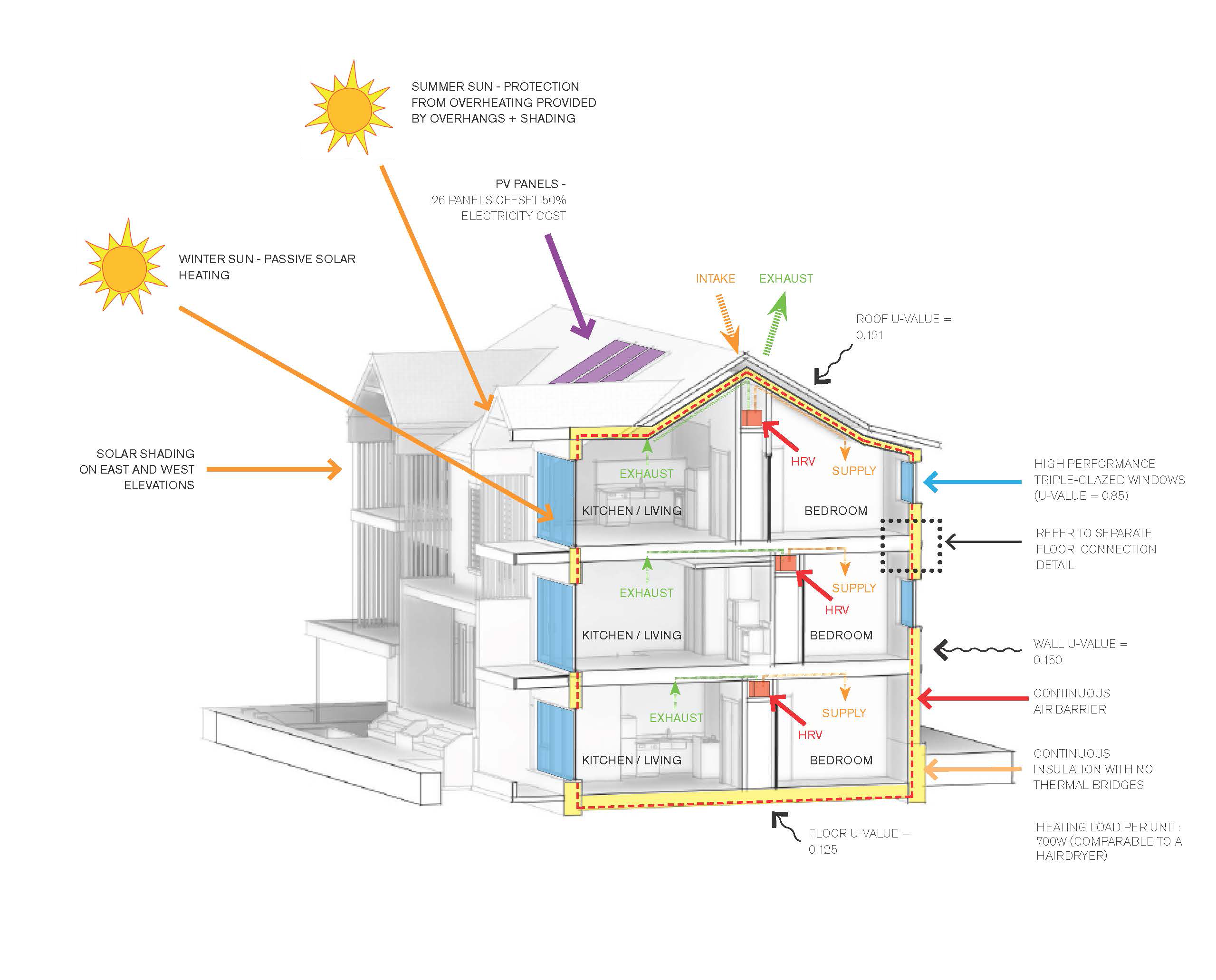
Improving indoor air quality by stopping moisture accumulation is just one way that they achieve this. Homes built to the Passive House standard use a building envelope's first approach consisting of insulation, air sealing, and no thermal bridging. Windows, doors, and any other penetrations in the building envelope are all extremely high-performing. A Passive House is oriented to best take advantage of the sun's energy for heating in the winter and shade in the summer.
The most common thermal bridge is a gap in insulation, but outlets, junction boxes, and plumbing can also act as thermal bridges. Thermal bridges are more common at corners, jogs, balconies, and discontinuities, which is why Passive House designs tend to be simpler. Air tightness minimizes infiltration of outside air and any loss of conditioned air. In these types of homes, for example, stale air from bathrooms, kitchens, and other areas is exhausted out and replaced with fresh air. At least 75 percent of the heat from the exhaust air is transferred to the fresh air by a heat exchanger.
The building envelope is what separates the interior of the building from the exterior; it consists of outside walls, roofs, and floors. In cold climates like Canada, where inside air is heated to keep the building comfortable, some of that heat will be lost as it moves through the envelope (via the process of conduction). In order to reduce this heat loss, insulation made of low-conductivity materials is installed within the wall and roof assemblies.
Foundations, walls, floors, doors, windows, and roofs are insulated without gaps between them. In a Passive House, the walls are thicker, often with three or more layers of materials and insulation cavities between them. The cavities can be filled with as much as 12 inches of densely packed cellulose, fiberglass, or other materials.
The entire building envelope including airtightness, windows, exterior wall systems and insulation are combined to produce significant energy cost savings not possible with conventional building practices. Although dehumidifiers might be used, heat pump hot water heaters also will act to cool and condense interior humidity (where it can be dumped into drains) and dump the heat into the hot water tank. Passive cooling, solar air conditioning, and other solutions in passive solar building design have been studied to adapt the "passive house" concept for use in more regions of the world. Not only are the windows and doors very high-performance, but their placement is essential. Passive House buildings are optimally oriented and designed to make the most of the available natural light and heat. Solar gain through passive solar heating is strictly managed to maximize heat gain in the winter while limiting overheating during the summer.


No comments:
Post a Comment